index_advisor: query optimization
Index advisor is a Postgres extension for recommending indexes to improve query performance.
Features:
- Supports generic parameters e.g.
$1,$2 - Supports materialized views
- Identifies tables/columns obfuscated by views
- Skips duplicate indexes
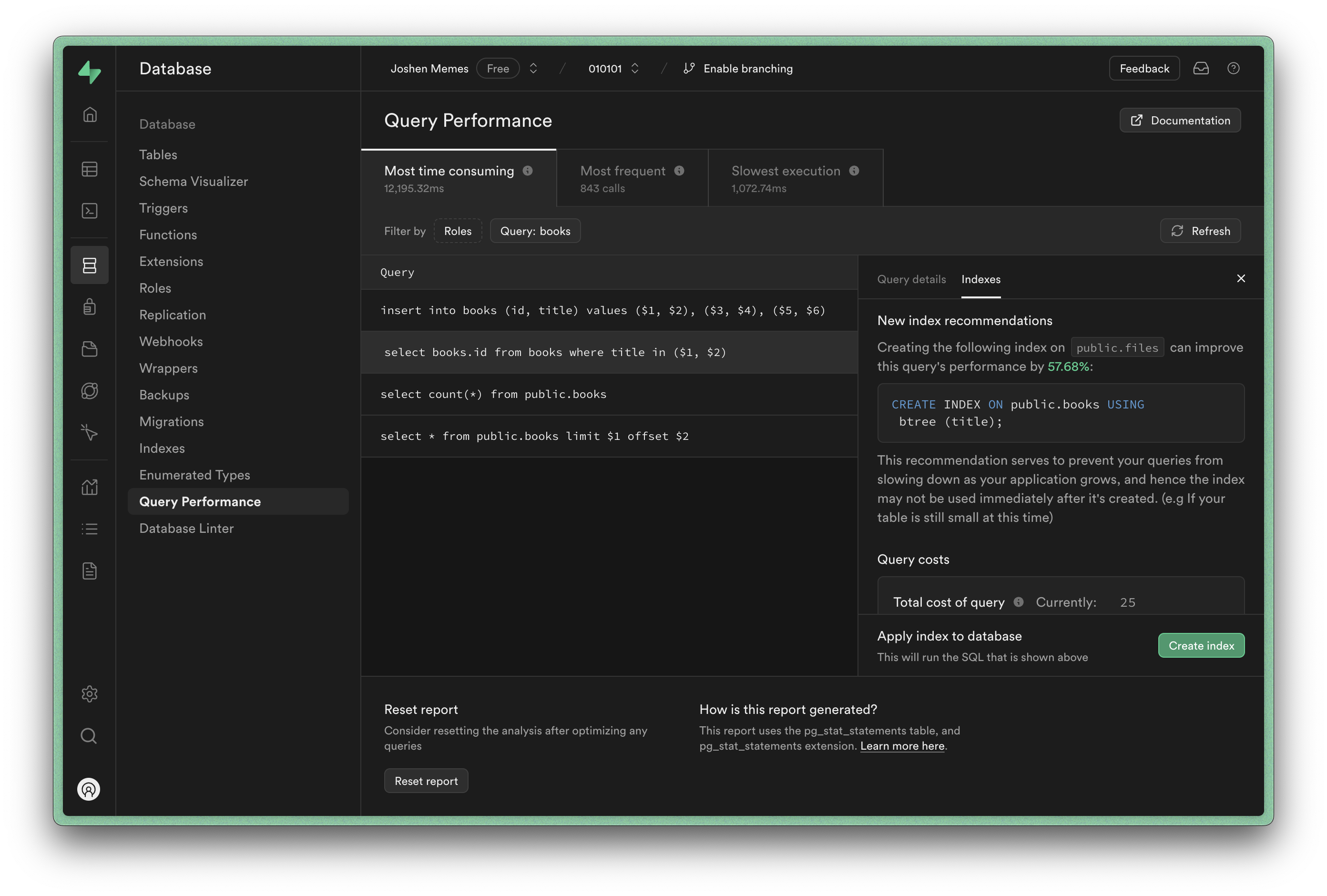
index_advisor is accessible directly through Supabase Studio by navigating to the Query Performance Report and selecting a query and then the "indexes" tab.
Alternatively, you can use index_advisor directly via SQL.
For example:
select *from index_advisor('select book.id from book where title = $1'); startup_cost_before | startup_cost_after | total_cost_before | total_cost_after | index_statements | errors---------------------+--------------------+-------------------+------------------+-----------------------------------------------------+-------- 0.00 | 1.17 | 25.88 | 6.40 | {"CREATE INDEX ON public.book USING btree (title)"},| {}(1 row)Installation#
To get started, enable index_advisor by running
create extension index_advisor;API#
Index advisor exposes a single function index_advisor(query text) that accepts a query and searches for a set of SQL DDL create index statements that improve the query's execution time.
The function's signature is:
index_advisor(query text)returns table ( startup_cost_before jsonb, startup_cost_after jsonb, total_cost_before jsonb, total_cost_after jsonb, index_statements text[], errors text[] )Usage#
As a minimal example, the index_advisor function can be given a single table query with a filter on an unindexed column.
create extension if not exists index_advisor cascade;create table book( id int primary key, title text not null);select *from index_advisor('select book.id from book where title = $1'); startup_cost_before | startup_cost_after | total_cost_before | total_cost_after | index_statements | errors---------------------+--------------------+-------------------+------------------+-----------------------------------------------------+-------- 0.00 | 1.17 | 25.88 | 6.40 | {"CREATE INDEX ON public.book USING btree (title)"},| {}(1 row)and will return a row recommending an index on the unindexed column.
More complex queries may generate additional suggested indexes:
create extension if not exists index_advisor cascade;create table author( id serial primary key, name text not null);create table publisher( id serial primary key, name text not null, corporate_address text);create table book( id serial primary key, author_id int not null references author(id), publisher_id int not null references publisher(id), title text);create table review( id serial primary key, book_id int references book(id), body text not null);select *from index_advisor(' select book.id, book.title, publisher.name as publisher_name, author.name as author_name, review.body review_body from book join publisher on book.publisher_id = publisher.id join author on book.author_id = author.id join review on book.id = review.book_id where author.id = $1 and publisher.id = $2 '); startup_cost_before | startup_cost_after | total_cost_before | total_cost_after | index_statements | errors---------------------+--------------------+-------------------+------------------+-----------------------------------------------------------+-------- 27.26 | 12.77 | 68.48 | 42.37 | {"CREATE INDEX ON public.book USING btree (author_id)", | {} "CREATE INDEX ON public.book USING btree (publisher_id)", "CREATE INDEX ON public.review USING btree (book_id)"}(3 rows)Limitations#
- index_advisor will only recommend single column, B-tree indexes. More complex indexes will be supported in future releases.
- when a generic argument's type is not discernible from context, an error is returned in the
errorsfield. To resolve those errors, add explicit type casting to the argument. e.g.$1::int.
Resources#
index_advisorrepo