Google Colab
Use Google Colab to manage your Supabase Vector store.

Google Colab is a hosted Jupyter Notebook service. It provides free access to computing resources, including GPUs and TPUs, and is well-suited to machine learning, data science, and education. We can use Colab to manage collections using Supabase Vecs.
In this tutorial we'll connect to a database running on the Supabase platform. If you don't already have a database, you can create one here: database.new.
Create a new notebook#
Start by visiting colab.research.google.com. There you can create a new notebook.
Install Vecs#
We'll use the Supabase Vector client, Vecs, to manage our collections.
At the top of the notebook, paste the following code and click "Execute" (ctrl+enter):
pip install vecs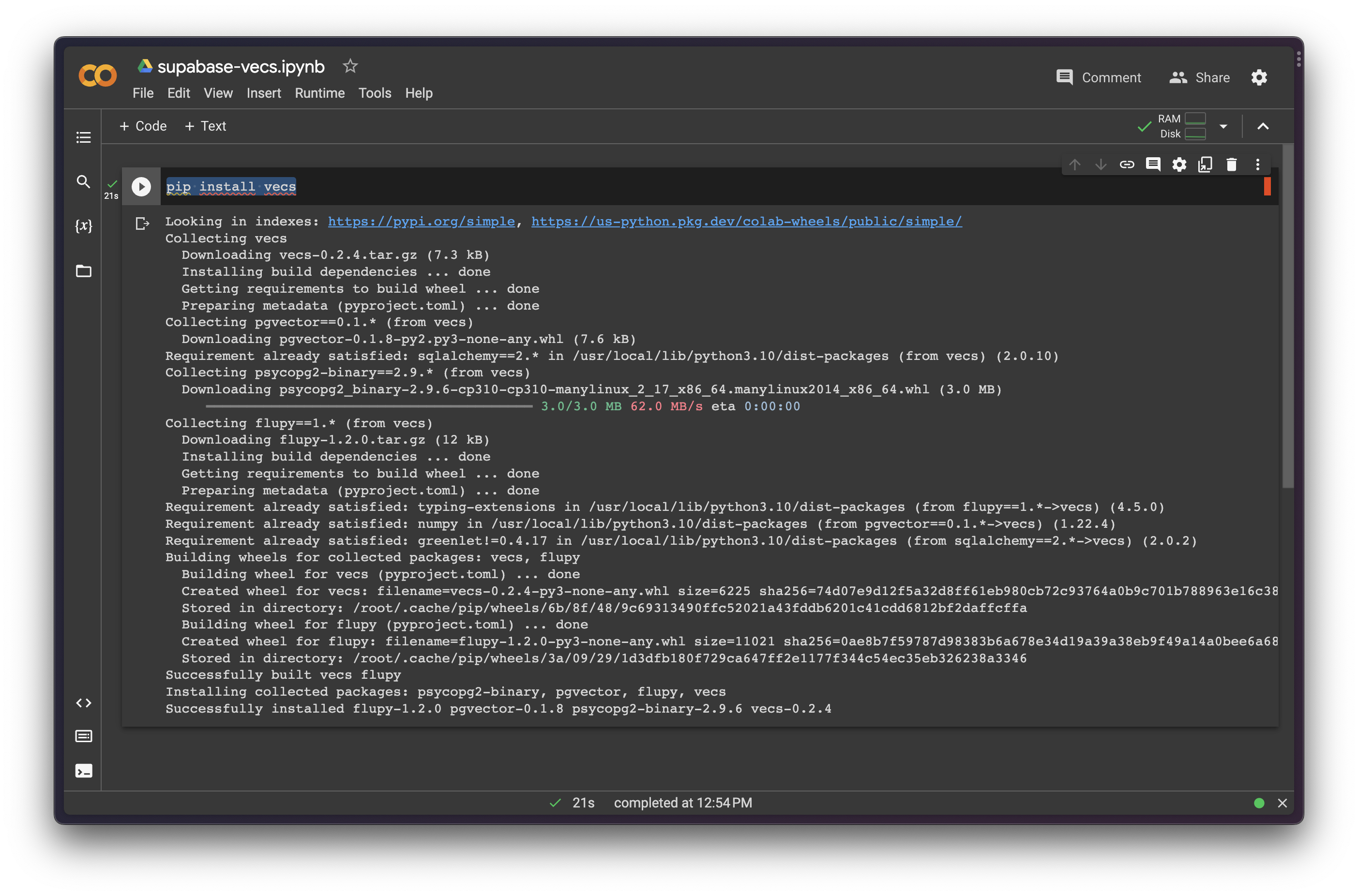
Connect to your database#
On your project dashboard, click Connect. The connection string should look like postgres://postgres.xxxx:password@xxxx.pooler.supabase.com:6543/postgres
Create a new code block below the install block (ctrl+m b) and add the following code using the Postgres URI you copied above:
import vecsDB_CONNECTION = "postgres://postgres.xxxx:password@xxxx.pooler.supabase.com:6543/postgres"# create vector store clientvx = vecs.create_client(DB_CONNECTION)Execute the code block (ctrl+enter). If no errors were returned then your connection was successful.
Create a collection#
Now we're going to create a new collection and insert some documents.
Create a new code block below the install block (ctrl+m b). Add the following code to the code block and execute it (ctrl+enter):
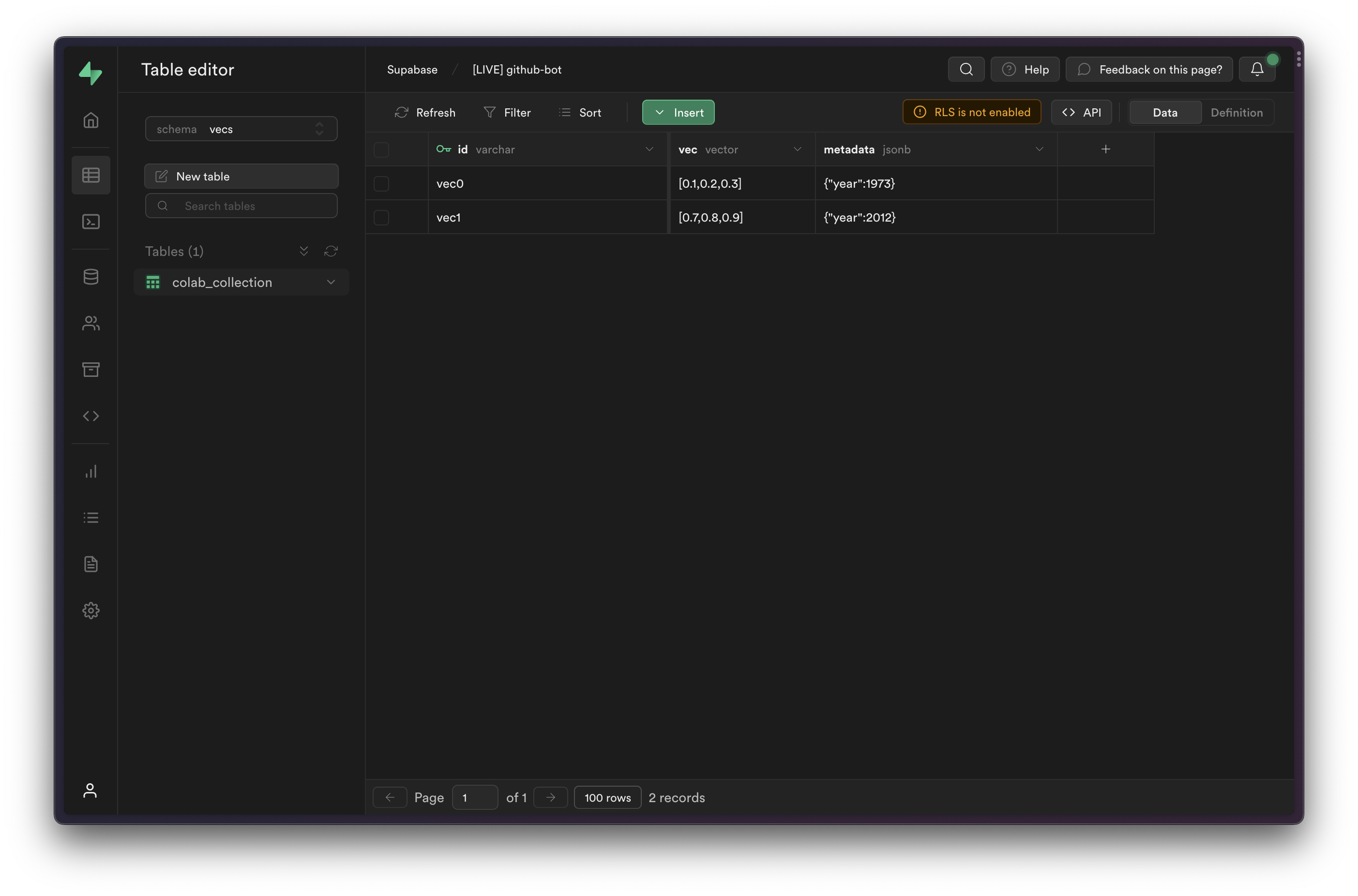
collection = vx.get_or_create_collection(name="colab_collection", dimension=3)collection.upsert( vectors=[ ( "vec0", # the vector's identifier [0.1, 0.2, 0.3], # the vector. list or np.array {"year": 1973} # associated metadata ), ( "vec1", [0.7, 0.8, 0.9], {"year": 2012} ) ])This will create a table inside your database within the vecs schema, called colab_collection. You can view the inserted items in the Table Editor, by selecting the vecs schema from the schema dropdown.
Query your documents#
Now we can search for documents based on their similarity. Create a new code block and execute the following code:
collection.query( query_vector=[0.4,0.5,0.6], # required limit=5, # number of records to return filters={}, # metadata filters measure="cosine_distance", # distance measure to use include_value=False, # should distance measure values be returned? include_metadata=False, # should record metadata be returned?)You will see that this returns two documents in an array ['vec1', 'vec0']:
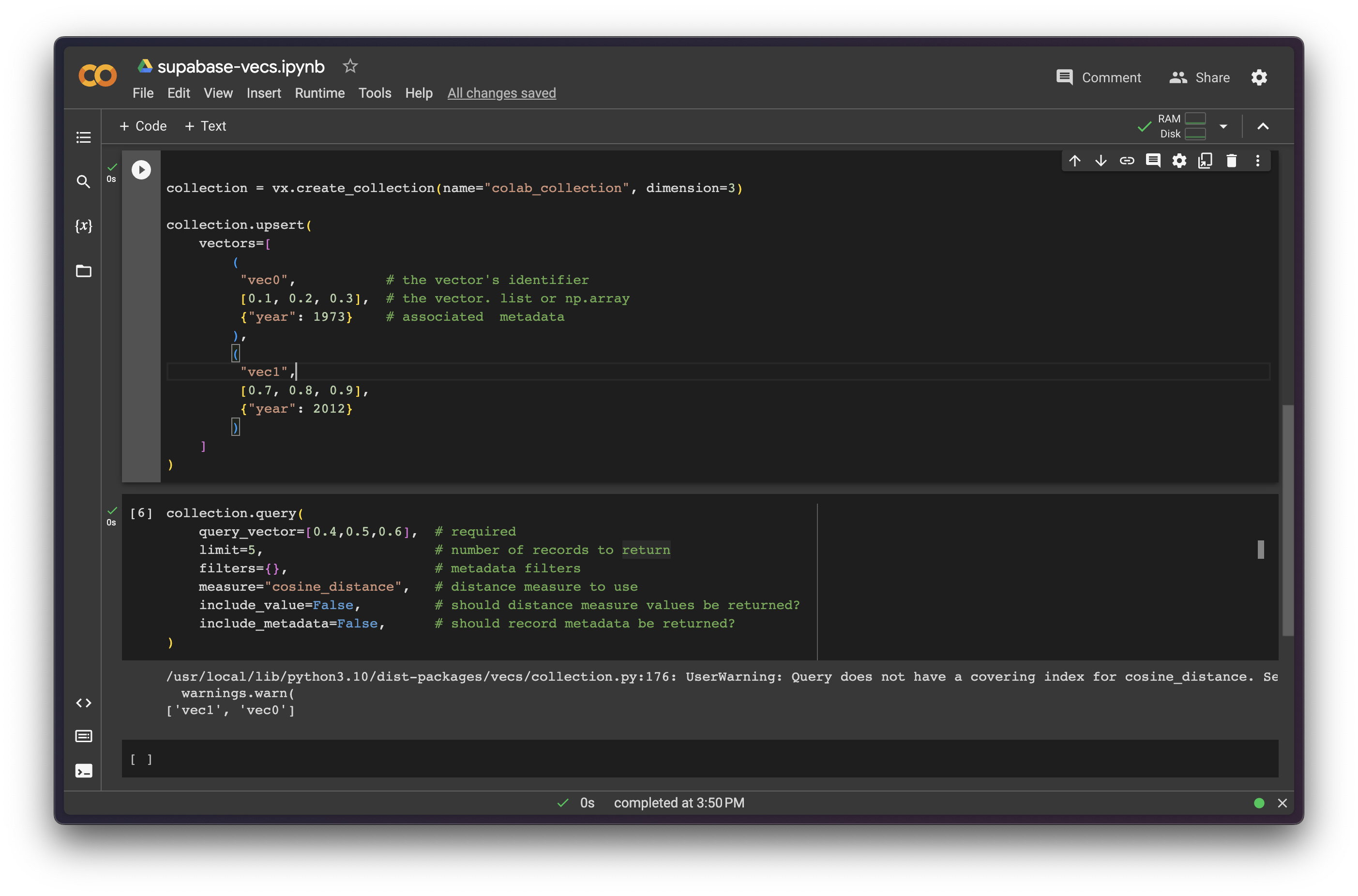
It also returns a warning:
Query does not have a covering index for cosine_distance.You can lean more about creating indexes in the Vecs documentation.
Resources#
- Vecs API: supabase.github.io/vecs/api